


Most home service contractors are not losing because of bad marketing. They are losing because of invisible mistakes they do not know to look for.
Some of these mistakes show up in your Google Ads account. Some live on your website. Some are hiding inside your Google Business Profile. And some have nothing to do with marketing at all — they are operational problems that quietly drain every dollar you spend trying to grow.
This article covers the biggest ones we see. For each one, we will tell you what to look for and what to do instead.
Mistake #1: Blending Branded and Unbranded Google Ads — and Thinking the Results Are Real
This is the most expensive invisible mistake in contractor marketing, and it is extremely common.
Here is how it works. An agency runs your Google Ads with branded campaigns (people searching your company name) and unbranded campaigns (people searching “AC repair near me” or “plumber in Dallas”) all lumped together into one reporting view. The blended ROAS looks solid. Maybe 4x or 5x. Everyone feels good about it.
But when you pull the campaigns apart, the story changes. The unbranded campaigns — the ones actually finding new customers — are often running at 1x to 2x ROAS. The branded campaigns, where existing customers who already know and trust you are searching by name, are carrying a 10x or 12x return that is propping the whole thing up.
You are essentially paying your agency to take credit for customers who would have called you anyway.
The fix: insist that your agency splits branded and unbranded campaigns and reports on them separately. If your agency resists this or cannot explain why the split matters, that is a red flag. Unbranded ROAS is the only number that tells you whether your advertising is actually finding new customers.
Mistake #2: Ignoring the Revenue Already Sitting in Your Business
Contractors are quick to spend money on marketing to find new customers. They almost never spend energy on the customers they already have.
In the home services industry, this is one of the most costly blind spots we see. When we dig into a new client’s ServiceTitan data, we routinely find hundreds of thousands of dollars sitting in open estimates that were never followed up on. Tune-up appointments that were never converted into repairs or replacements. Past customers who have not heard from the business in two or three years.
Here is the reality: most homeowners actually want to hear from the brands they do business with, especially when those brands are local and did good work. They are not annoyed by a follow-up. They are waiting for one.
The contractors who get this right build a consistent outreach rhythm — email campaigns to past customers, automated follow-ups on open estimates, seasonal check-ins before peak demand hits. They do not call their customer list only when they are desperate for work. They nurture the relationship year-round so the phone rings before desperation sets in.
The fix: run a database reactivation campaign to your existing customer list. Pull your open estimates from the last 12 months and build a follow-up sequence. This is typically the fastest revenue a contractor can unlock without spending another dollar on advertising.
Mistake #3: DIY SEO That Gets Some Things Right and Misses the Things That Matter
Contractors who try to handle their own SEO are usually not wasting their time entirely. Getting a few service pages up and publishing some content is better than nothing. The problem is the technical layer underneath, which most contractors have no way of knowing exists.
Here is what typically gets missed:
**Internal linking.** Pages on your site need to connect to each other in a logical way. Google follows those links to understand the structure of your site and the relationship between your services. A site where pages do not link to each other is a site Google struggles to crawl and understand.
**Service and location pages.** Every service you offer should have its own dedicated page. Every city you serve should have a dedicated page with the services you offer in that location. Most DIY sites have one services page and one contact page. That is not enough.
**Schema markup.** Schema is code that tells search engines exactly what your business does, where you are located, what your reviews say, and what services you offer. Most contractors have never heard of it. In the world of AI search, schema is increasingly how Google and AI platforms understand and surface local businesses. Leaving it out is a significant missed opportunity.
**Image optimization.** The photos on your site should be real, authentic images of your work and your team. Stock photos hurt you. But beyond that, your images should be geo-tagged to your service location, have a filename that describes what is in the photo, and include alt text that helps Google understand the content. These details matter more than most people realize, especially as AI search expands.
**Off-page signals: citations, directories, and press.** Getting your business listed accurately across major directories has made a strong comeback. Getting listed on “top 10 HVAC companies in [city]” style pages is now one of the higher-value off-page signals you can earn. A smart way to find new citation opportunities is to search ChatGPT for lists of top contractors in your market — their source pool is wider than Google and surfaces directories and list sites that traditional SEO tools miss.
Press releases done correctly can rank for important local terms, build GBP authority, increase AI search citations, and compound organic growth over time. The screenshot below shows what this looks like when it is working — organic keywords up 122% and AI visibility building in ChatGPT and Gemini without a single dollar in paid ads.

The fix: if you are doing your own SEO, hire someone to do a technical audit before you spend another hour on content. You may be building on a cracked foundation.
Mistake #4: A Website That Looks Fine But Is Actively Costing You Leads
When a contractor builds their own website, the result is usually a Wix or Squarespace template filled with stock photos, generic content, and buttons that do not work correctly. The site loads slowly. It is not built for mobile users, who make up the majority of home service searches. It has no blog, no location pages, no service depth, and it just looks old.
These sites do not rank for much. And when someone does land on them, the trust signals are not there to convert a visitor into a call.
The hard truth is that sites like this usually cannot be fixed. They have to be rebuilt. The platform, the structure, and the content all need to start over. That is an expensive lesson when you factor in the time the site was live and not working.
What a good contractor website needs: fast load times on mobile, real photos of your team and your work, a unique page for every service, a unique page for every city you serve, clear calls to action above the fold, and a blog that answers the questions your customers are already searching for. None of this is optional if you want the site to rank and convert.
The fix: before you build a website, ask the agency or developer what platform they use and whether you will own the site when the engagement ends. A WordPress site built correctly is transferable to any agency. Proprietary platforms are not.
Mistake #5: Getting Google Business Profile Wrong at Every Level
Your Google Business Profile is often the first thing a homeowner sees when they search for your service. It drives calls, directions, website visits, and bookings. Most contractors have one and almost none have it fully optimized.
Here are the most common mistakes we see:
**Wrong primary category.** Most HVAC contractors choose “HVAC Contractor” as their primary category. That is not wrong, but it misses the seasonal opportunity. In summer, “Air Conditioning Repair Service” outperforms. In winter, “Furnace Repair Service” is the stronger choice. Matching your primary category to the season — and pairing it with a landing page that matches that category and your city — has a measurable impact on local visibility. The before-and-after rank maps below show what this looks like in practice.

**Your location is outside Google’s city limits.** Many contractors have a USPS mailing address that says they are in a certain city, but their physical location falls outside of what Google defines as that city. You can check this yourself by going to Google Maps, typing in your city, and looking at the red dotted boundary lines. If your pin is outside those lines, you will struggle to rank inside that city no matter how good your profile is. We have had clients who needed to either move their location or open a second listing in the city where their ideal customers actually live.
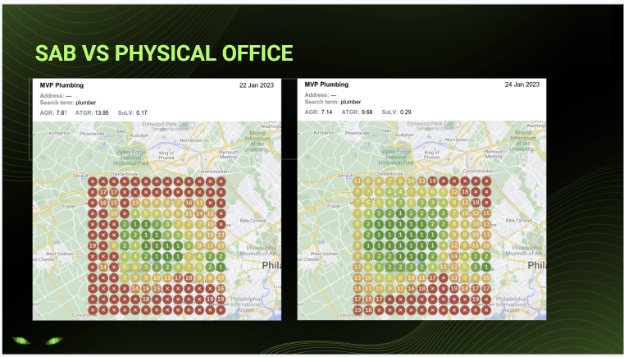
**Service Area Business vs. physical office.** A Service Area Business — the kind you set up when you are working out of your home — ranks significantly worse than a profile tied to a physical address. We will not take on a client who has only SAB listings without first ensuring they secure at least one physical office. The rank map below shows the difference for a plumbing client who made this switch.
**The city limits issue at scale.** The image below shows a Bozeman, Montana example where a client’s physical location was outside the city boundary. The rank map showed strong rankings in the surrounding area but poor performance in the core of Bozeman, which was where their best customers were. Location matters more than most contractors think.

**Business name missing a keyword.** This is one of the highest-impact GBP ranking factors and one of the most underused. A business name that includes an important keyword — even as a DBA — gives Google more context about what you do and unlocks ranking potential that generic names do not have. We typically work with clients to establish a DBA that includes their primary service or a key term.
**Too few secondary categories.** Most contractors add one or two secondary categories when they first set up their profile. Most would qualify for five to seven. Each additional category gives Google more context about your services and increases the number of searches your profile is eligible to appear for.
**Neglecting the basics.** This sounds simple but it is widespread: contractors do not post photos, do not make Google posts about services or promotions, do not share five-star reviews as posts, do not fill out their description and services with detail, and do not respond to reviews consistently. All of these signals matter to the algorithm and to the homeowner reading your profile before they decide to call.
The fix: treat your GBP like a living marketing channel, not a one-time setup task. It requires regular posts, photo updates, review responses, and seasonal category adjustments to stay competitive.
Mistake #6: Disconnecting Marketing Performance From Operational Performance
This is the mistake nobody talks about at a marketing conference, but it undermines more contractor businesses than bad SEO ever will.
Marketing can fill your phone. It cannot make your CSR book the call. It cannot make your technician close the job. It cannot fix pricing that does not support a healthy margin.
We have seen contractors run great campaigns, generate strong call volume, and still wonder why revenue is not growing. When we dig into the operational data, the picture becomes clear. Their call booking rate numbers look acceptable on paper, but there are no defined criteria the team actually follows. The data is unreliable. Their CSRs have not been trained on booking rate fundamentals, so opportunities are leaking out of the top of the funnel before they ever become jobs.
Even further downstream, most contractors do not track their technicians’ closing rates. Closing rate in the trades is typically defined as selling something above the service or diagnostic fee — actually getting a repair or replacement rather than just collecting a trip charge. If your techs are not closing, your marketing spend is subsidizing a free estimate service.
And underneath all of this: if your pricing is not dialed in and you do not know your margins at the job level, you can be busy and still not be profitable.
The fix: marketing and operations are one system. Before you increase your ad spend, make sure you know your real booking rate, your real close rate, your average ticket by service type, and your margin by job. A good marketing agency should be asking you these questions. If yours never brings them up, you are not getting a partner — you are getting a vendor.
The Common Thread
Every mistake on this list comes back to the same thing: lack of visibility.
Contractors spend money on marketing without knowing what is actually working. They run ads without knowing if those ads are finding new customers or just capturing existing ones. They build websites that look fine and do not rank. They have GBP profiles that are incomplete. They have customer databases they never contact. And they measure marketing results without connecting them to what happens after the phone rings.
The contractors who grow consistently are the ones who close those visibility gaps — in their marketing, in their operations, and in the connection between the two.
*Relentless Digital works exclusively with HVAC, plumbing, electrical, and roofing contractors. If you want to know where the gaps are in your current marketing, start a conversation with us at booking.relentless-digital.com.*