

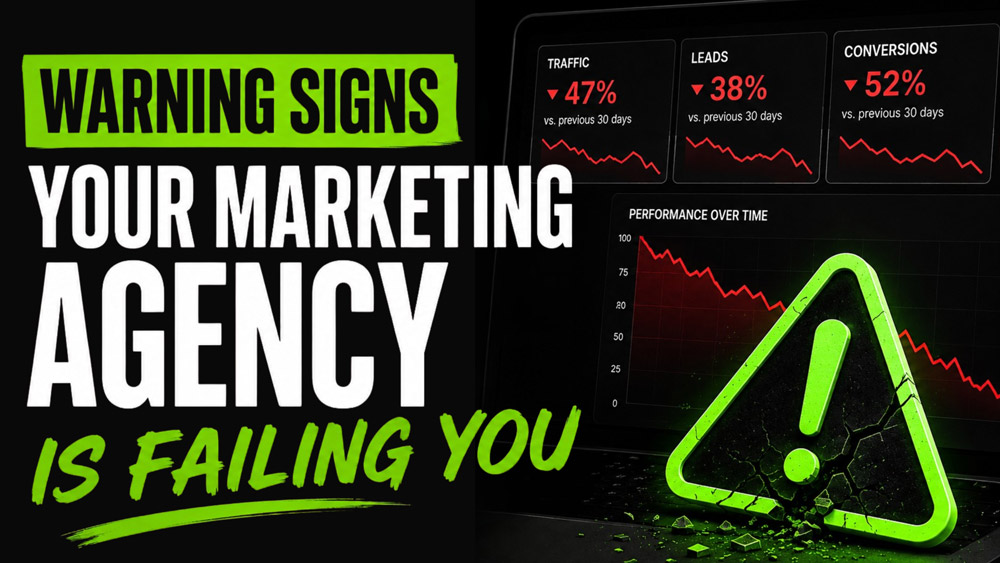
You signed a contract. You paid the retainer. And now, months later, you are not sure what your marketing company is actually doing.
You are not alone.
Most home service contractors have been burned by a marketing agency at least once. The frustrating part is that the warning signs were usually there early. They just did not know what to look for.
This article breaks down 8 warning signs that your current marketing agency is failing you. For each one, we will also show you what good looks like so you know exactly what to demand.
Warning Sign #1: You Have Had Multiple Account Managers in a Short Period of Time
This is the most common complaint we hear from contractors who come to Relentless Digital after leaving another agency.
You sign up. You meet your account manager. You start to build a relationship. Then three months later, you get an email saying your account has been reassigned. Then it happens again.
Every time your account manager changes, your history goes with them. The new person has to start from scratch. They do not know your seasonality, your service area, your best customers, or what you tried six months ago that did not work. You spend the first call re-explaining your business instead of talking strategy.
High turnover inside an agency is a signal that something is broken. It might be the culture, the pay, the workload, or leadership. Whatever the reason, you are the one who pays the price.
What good looks like: A dedicated point of contact who knows your business, stays consistent, and can speak to your results without needing to pull up notes to figure out who you are.
Warning Sign #2: You Do Not Know What Your Agency Is Actually Doing
If you asked your agency right now to walk you through exactly what they worked on last month, could they answer you clearly and specifically?
If the answer is vague or you get a 47-page PDF full of graphs you do not understand, that is a problem.
Contractors should not need a marketing degree to understand what their agency is doing on their behalf. A good agency explains their work in plain language. You should know what content was published, what campaigns are running, what was tested, and what is coming next.
Confusion is not a sign that the work is sophisticated. It is often a sign that the agency does not want you asking too many questions.
What good looks like: Monthly strategy calls where your account manager walks you through exactly what was done, what results came from it, and what the plan is for next month. Larger clients on bigger programs may need two or three touchpoints per month to stay fully aligned.
Warning Sign #3: Your Reports Are Full of Numbers That Do Not Connect to Revenue
Impressions. Keyword rankings. Page views. Domain authority. Social reach.
These are vanity metrics. They look impressive on a report. They are easy to inflate. And they tell you almost nothing about whether your marketing is growing your business.
A stat worth knowing: agencies hiding behind vanity metrics cost clients an estimated $8,400 to $15,700 per year in wasted spend while real revenue impact goes unmeasured. Meanwhile, 73% of businesses end their SEO contracts within six months specifically because the reporting is too opaque to show ROI.
You should be able to open your monthly report and answer one question: is this making me money?
The metrics that matter for a home service contractor are calls generated, booked appointments, booking rate, cost per lead, and return on ad spend. If those numbers are not front and center in what your agency sends you, ask why.
What good looks like: A reporting dashboard that shows you performance in business terms. You should be able to see what leads came in, what they cost, what your booking rate was, and where your money is going. No jargon. No fluff. Just the numbers that run your business.
Warning Sign #4: You Do Not Actually Own Your Stuff
This one is a gut punch when contractors find out.
You paid for the website. You paid for the Google Ads campaigns. You have been paying for the content every month. But when you ask to take it all with you, you find out you do not own any of it.
We have seen this play out in a few different ways.
Proprietary website platforms. Some agencies build your website on their own system. It looks great and works fine as long as you are their client. The moment you try to leave, you find out the site cannot be transferred. You have two options: pay a ransom fee to keep the domain and content, or start over from scratch. Even if you pay the fee, the back-end system is usually so locked down that another agency cannot work in it anyway. You end up rebuilding either way.
For context, a WordPress site built correctly is transferable to any agency. It is the industry standard for a reason. If your agency is building you on a proprietary platform, ask them directly: what happens to this site if we part ways?
Google Ads account ownership. When you start a new Google Ads account, the platform goes through a learning period. It takes two to three months before the algorithm has enough data to optimize your campaigns properly. If your agency owns the account and you have to start fresh when you leave, you lose all of that historical data. That means two to three months of paying for underperforming ads while the new account catches up.
Always make sure the Google Ads account is created under your business, not your agency’s manager account.
Local Service Ads billing. We have seen contractors come to us with the agency’s credit card on file for their LSA account. When the relationship ends or the agency’s card stops processing, the ads shut off. No warning. No transition. Just silence on the phone.
Your billing information should always be in your name, under your control.
What good looks like: A trustworthy agency works for you, not around you. At Relentless Digital, our philosophy is simple. You own everything. Your website, your ad accounts, your Google Business Profile, your call tracking numbers, your data. If you ever decide to leave, you take all of it with you. We built it for your business, not ours.
Warning Sign #5: You Are Trapped in a Contract With No Clear Way Out
Read your contract before you sign it. Specifically, find the cancellation clause.
Some of the larger agencies in this space use contracts with a very short and very specific cancellation window. Miss that window, and the contract auto-renews. You are locked in for another year before you even realize what happened.
One contract structure we have seen: a one-year agreement that starts when you sign, then resets for another full year when your website launches. Most contractors did not read that clause and had no idea they had just committed to two years.
We want to be transparent about our own contract. Our initial agreement is 12 months. That is intentional and we will tell you exactly why.
Google Ads takes roughly three months to get off the ground. SEO takes three to six months to gain real momentum. By the time the work is actually producing consistent results, you are already halfway through a 12-month agreement. A 30-day or 90-day contract does not give either side enough time to do the work correctly.
What we do in the meantime is not nothing. We focus on fast-win strategies like outbounding to your existing customer base, email campaigns to re-engage past clients, and setting up speed-to-lead systems so no inbound lead gets missed while the long-term channels are building.
The difference between a fair contract and a trap is transparency. You should know exactly what you are signing, exactly when you can exit, and exactly what happens to your assets if you do.
What good looks like: A clearly written agreement where the cancellation terms are easy to find and easy to understand, and where your assets stay yours no matter what.
Warning Sign #6: They Go Silent After You Sign
Before you signed, the agency was responsive, attentive, and enthusiastic. You felt like a priority.
Then the contract was countersigned and the calls stopped coming.
This is one of the most common complaints in the home services marketing space. Contractors feel ghosted. Questions go unanswered for days. When you do get a response, it is a form reply. Nobody reaches out proactively. You are left wondering if anything is actually happening.
A good agency runs toward problems, not away from them. If something changes in your market, your account manager should be the one calling you, not the other way around.
What good looks like: Response time of one business day or less for any request. Monthly strategy calls as a baseline. Proactive outreach when something changes in your market, in Google’s algorithm, or in your campaign performance. If something new is worth knowing, you should hear about it from your account manager before you hear about it anywhere else.
Warning Sign #7: They Lead With Guarantees
If an agency opens their pitch with “guaranteed first-page rankings” or “we’ll double your leads in 60 days,” close the tab.
Guaranteeing outcomes in marketing is either naive or dishonest. Usually both.
The marketing landscape shifts constantly. Google has rolled out AI Overviews that are changing how much organic traffic reaches contractor websites. Facebook’s Andromeda update changed how audience targeting works. What was true about SEO 18 months ago is not entirely true today.
The word “guarantee” in a marketing contract almost always comes with a clause buried in the fine print that lets the agency define success on their own terms. The leads that count toward a “guarantee” may be recycled, low-quality, or geographically irrelevant to your business. You get the number, but not the results.
There is also a deeper point here. A marketing agency can only control their side of the equation. They can grow your visibility, get qualified people to call your business, and make sure your phone rings. But if your call center does not convert those calls into booked appointments, if your technicians cannot close, or if your pricing is misaligned with your market, you will not see a return no matter how good the marketing is.
That is why we talk about partnership. A good agency asks hard questions about your whole business, not just your marketing budget.
What good looks like: An agency that gives you honest projections based on your market, your budget, and your goals. One that talks about realistic timelines and explains the variables they cannot control. If an agency promises certainty, they are selling you something they cannot deliver.

Warning Sign #8: They Only Talk About Marketing, Never About Your Business
Marketing does not exist in a vacuum. It feeds your phone, your schedule, and your revenue. A marketing agency that never asks about your booking rate, your average ticket, your close rate, or your seasonal capacity is an agency that is only paying attention to their slice of the pie.
The best agencies behave like a growth partner, not a vendor. They want to know if your Monday morning call queue is overflowing or empty. They want to know what your dispatcher is saying when leads call in. They care whether the leads they are generating are turning into revenue or dying somewhere in your pipeline.
If your monthly calls with your agency never go beyond “here is what we posted this month and here is your traffic report,” you are not getting the partnership you are paying for.
What good looks like: Conversations that connect marketing activity to operational outcomes. Your account manager should be asking about call booking rates, open estimates from last month, and what operational changes might help close the gap between the leads coming in and the revenue going to the bank.
What to Do If You Recognize These Signs
Read this list and feel a pit in your stomach? Here is the practical path forward.
Step 1: Have a conversation. Do not fire your agency the moment you spot a red flag. It is always easier and less expensive to repair a relationship than to start a new one. Request a meeting. Come prepared with specific examples of where things have fallen short. Give them the chance to address it.
Step 2: Watch what changes. If the conversation goes well, give it 30 to 60 days to see if the behavior actually changes. Good agencies respond to honest feedback. They tighten up their communication, bring better reporting, and take your concerns seriously.
Step 3: Ask to offboard if things do not improve. If the conversation went poorly, or if nothing changed after you raised the issues, it is time to exit. When you do, make sure you are walking away with everything that belongs to you. Your website files, your ad account access, your Google Business Profile ownership, your call tracking numbers, and your data.
The Bottom Line
Most contractors do not leave a bad agency because they figured out it was bad. They leave when they finally decide the frustration is not worth it anymore.
You do not have to wait that long.
A good marketing agency communicates clearly, reports on the metrics that matter, owns nothing that belongs to you, and acts like a partner in your business, not just a vendor on your invoice.
If you are not getting that, you deserve better.
At Relentless Digital, every client owns 100% of their digital assets from day one. If you are curious what a transparent, contractor-first agency relationship actually looks like, start a conversation with us at booking.relentless-digital.com.