

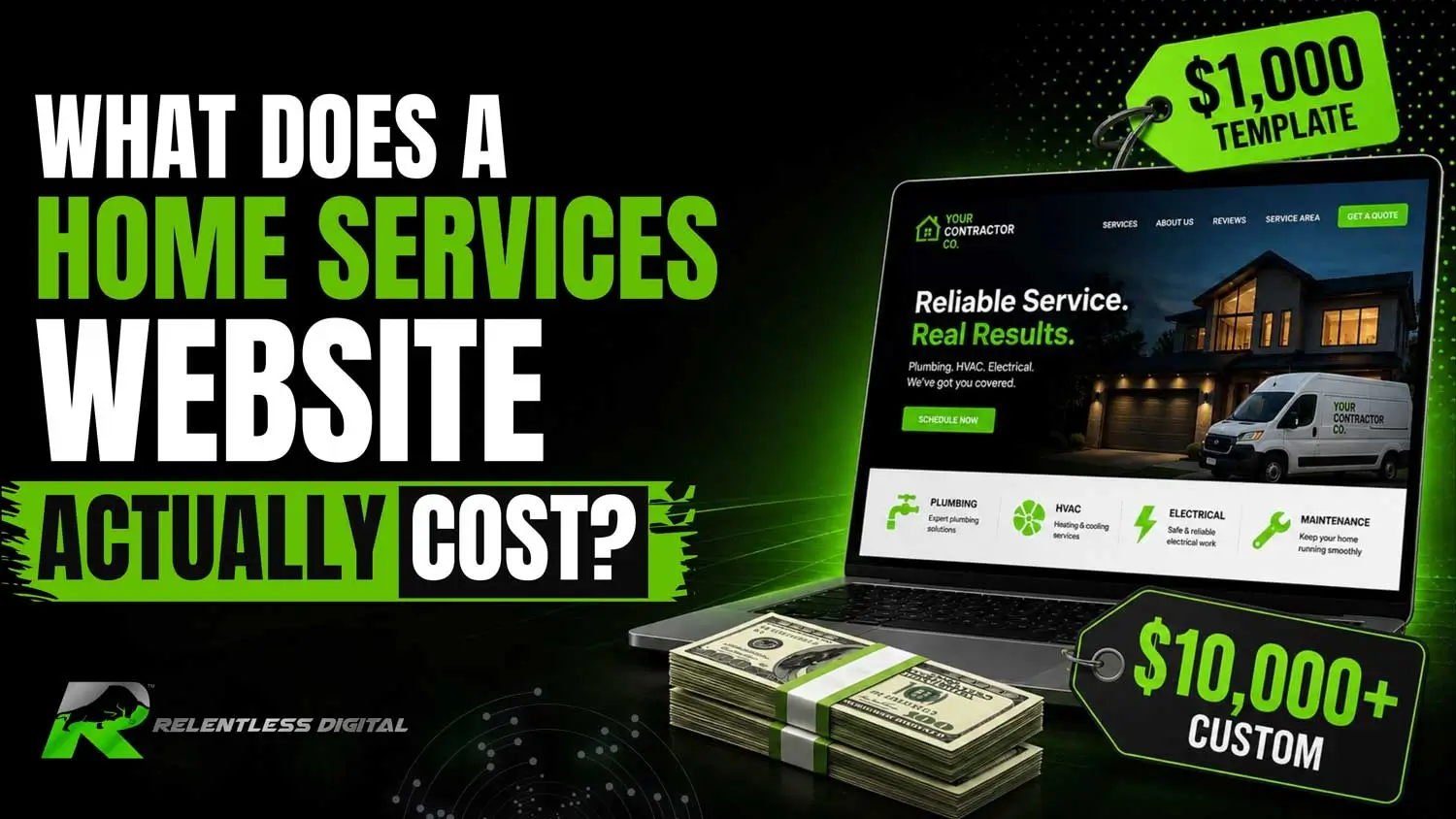
If you ask five website companies what a contractor website costs, you’ll get five different answers. And most of them won’t explain why.
I’ve seen contractor websites go from $2,000 all the way to $30,000. That’s a huge spread, and it leaves most owners guessing. So in this article I’m going to break down what drives that price, what a cheap site actually costs you later, what to look for in a proposal, and what you should expect after launch. Real numbers, no dancing around it.
Why Contractor Website Prices Range from $2,000 to $30,000
A lot of it comes down to the size and skill of the team building the site, and how deep the site actually goes.
You can get sites pretty cheaply these days through AI builders. Here’s the problem. Most of those platforms build decent-looking sites, but they’re missing a lot when it comes to SEO functionality. They’re also hard to update because your site lives in someone else’s Lovable, Claude, or Bolt account. You don’t control it.
Even WordPress builds vary a lot. A typical $2,000 site includes a few pages. That’s not bad if you’re just starting out. But Google and AI search platforms need a lot more information about your business than a few pages can give them.
Here’s the rule that changes everything: every single service you offer should be its own page. Air conditioning repair, air conditioning maintenance, and air conditioning installation should be three completely separate pages, each with unique, in-depth content. To be complete, each page needs 1,000 to 2,000 words.
On top of that, if you’re a service business, you need location pages that detail the work you do in each city you serve. That’s how search engines understand who you serve and your level of expertise in those cities. Good location pages also include information about the houses and common problems in that city, so the content is unique and stays indexed.
Getting to that level of depth takes real work. That’s why it’s almost always worth paying more for your website.
For reference, we build websites in four programs at Relentless Digital. Kickstart is for our smallest clients and includes 10 service pages and your top 5 location pages. Foundation includes 15 service pages and 10 locations. Growth includes 25 and 15. Relentless includes 40 and 25.
One more thing that drives price up: custom coded solutions. For most home service companies, this is unnecessary. If a proposal is loaded with custom development, ask why.
What a Cheap Contractor Website Really Costs You
A cheap website is almost always easy to spot.
Thin content. Very few images, and the ones that are there are stock photos reused over and over. Stock images do very little to separate your brand from your competitor down the street. People buy from people, and homeowners can spot stock photos a mile away.
The pages usually load slowly, too.
But here’s the hidden cost nobody talks about. Contractors with cheap sites end up rebuilding their website every single time they switch companies. By the time a contractor gets to us, they’ve often paid for two or three websites. Add those up and the “cheap” option costs more than doing it right once.
That’s part of why we build on WordPress, which powers about 40% of the internet. Our sites are always transferable. If you ever leave, the site goes with you.
How to Evaluate a Website Design Proposal
Comparing website quotes side by side is hard because there are usually hidden things unaccounted for. Here’s what to dig into.
Ask About Images
If the website company doesn’t ask for your photos or never brings up images at all, they’re using stock. That hurts your brand and your conversion rates.
Ask About Page Speed
This usually isn’t talked about until you find out much later that your site takes 10 seconds to load. By then it’s your problem.
Ignore Page Count, Look at Page Quality
The number of pages matters far less than what’s on them. Ask for recent site examples and actually read the content. Does it seem thorough? Does it read like that company knows your industry?
Check How Their Client Sites Rank
Do some searches and see if their client sites show up for important keywords. If nobody can find your site, it doesn’t matter how pretty or ugly it looks.
Ask About AI Search Optimization
This is where most website companies fall short, because AI search is new and most haven’t caught up. Two technical things matter here.
First, there’s a newer file called llms.txt that’s worth having on your site. It’s a simple file that gives AI tools a clean summary of your most important pages so they can understand your business faster. It’s still an emerging standard, and not every AI platform uses it yet, but it costs almost nothing to add and positions your site for where AI search is heading.
Second, every page needs schema, also called structured data. That is the code that computers use to understand your content. Local business schema, organization schema, review and product schema, and blog posting schema all matter.
Most contractors won’t think to ask about any of that. Now you will.
What Happens After Website Launches
A website isn’t done the day it goes live. Once a site launches, a real SEO team has post-launch work to do: optimizing meta titles and descriptions, getting pages indexed, redirecting old URLs to the new pages with 301 redirects, and testing everything from call buttons to forms to scheduling tools.
That indexing piece matters more than people realize. We use a special tool to help pages get indexed faster. Without something like that, you’re at the mercy of Google’s timeline.
Then there are the ongoing costs. Here’s how it works with us, so you have a real benchmark. After the site is paid for, hosting and maintenance runs $300 per month. That covers plugin updates, site speed checks, and adjustments if performance ever slips. To make the build itself more affordable, we usually offer 6 or 12 month financing at zero percent interest.
And this part matters most: once the site is paid in full— you own it. You can take it with you if you ever leave our services. Plenty of companies in this industry hold websites hostage when a client leaves. Ask any website company, in writing, who owns the site when you’re done paying.
Beyond hosting, our monthly SEO programs keep building on the foundation: adding more service pages, location pages, and blog content, and rewriting pages that don’t perform.
What a Good Website Investment Looks Like: An HVAC Case Study
Here’s a real example. An HVAC company in Missouri came to us invisible online. They did great work and their customers loved them. Their reviews were very good. But when homeowners searched for AC repair in their area, they didn’t show up. Their organic traffic was flat and they were leaving money on the table every single day.
We built them a brand new website and rebuilt their entire online foundation from the ground up. We optimized their Google Business Profile, launched a content strategy targeting the service and location combinations that actually drive calls, and fixed the technical issues that had been holding their old site back.
Here are the year-over-year results:
| Metric | Year-over-Year Result |
| Google impressions | +630% |
| Clicks from Google | +300% |
| Organic traffic | +166% |
| Monthly leads | 35 → 108 (more than tripled) |
| First-time callers per month | 21 → 64 (more than tripled) |
| Booking rate | 53% → 66% |
More traffic is nice. Getting more leads that actually book is the whole point. They went from invisible to unavoidable.
That’s what the right website investment does. It’s not magic. It’s math. The site is the foundation. Your rankings, your leads, and your booked calls all get built on top of it.
How Much Should You Budget for Your Contractor Website?
Expect to pay somewhere between $2,000 and $30,000 for a contractor website, and understand what each end of that range gets you. A few pages might be fine on day one, but Google and AI search reward depth: a page for every service, a page for every city, real photos, fast load times, and the technical details like schema and llms.txt that most builders skip.
And whatever you do, make sure you own it when it’s done.
If you’re trying to figure out what your business actually needs, let’s talk. We’ll look at where you are, tell you which of our programs fits, or tell you if you don’t need us yet.
Contact Relentless Digital and let’s figure out the right site for your business.