

Ask a contractor how many Google reviews they could get if they asked every customer they’ve ever served, and you’ll usually get a shrug and a small number. “Most people won’t bother.” “We already ask.” “The ones who’d write something already did.”
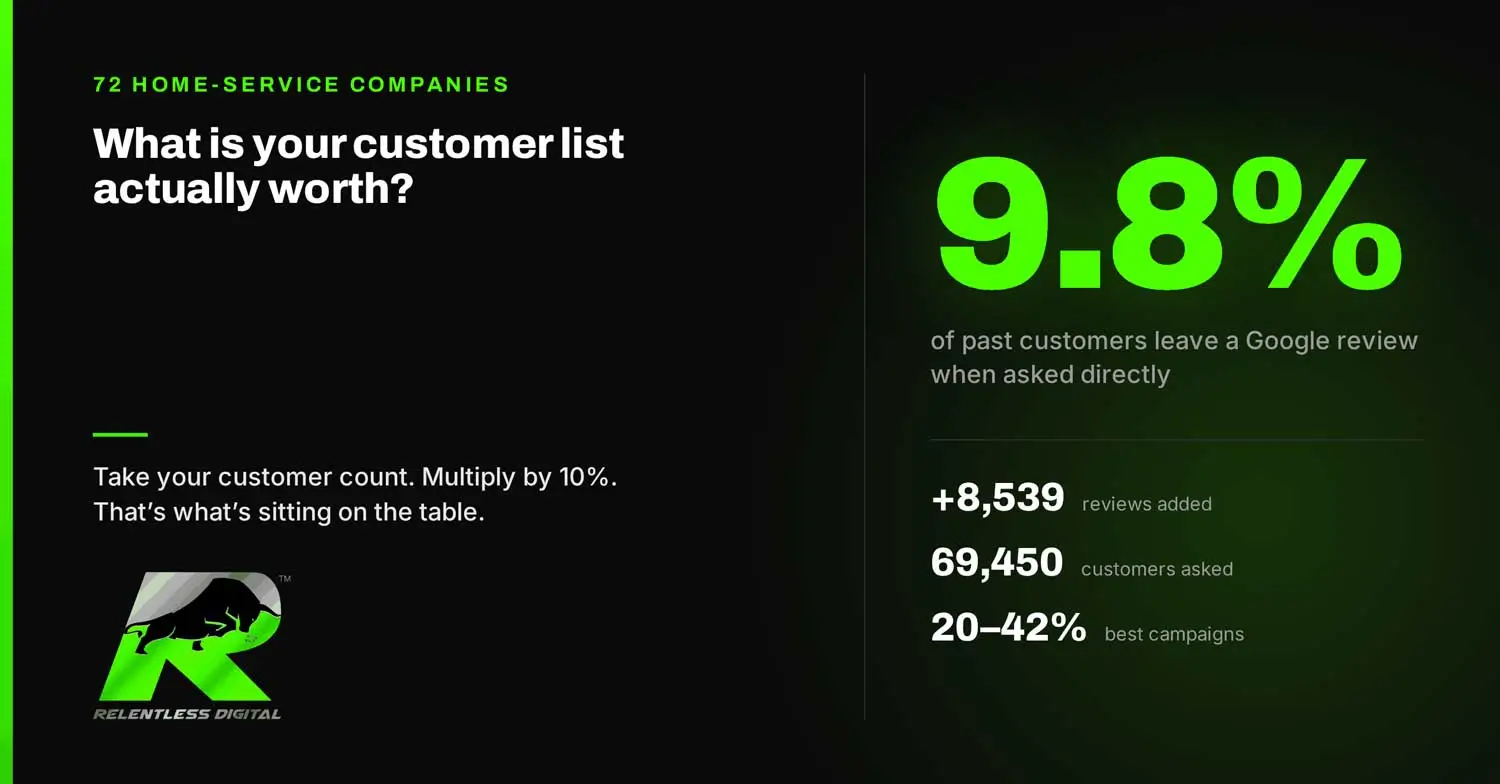
We’ve now run that exact experiment across 72 home-service companies — HVAC, plumbing, electrical, roofing — and the number isn’t small. Of every 100 past customers contacted, roughly 10 left a Google review. Not 10 who opened the message. Ten who went to Google, typed something, and hit publish.
Across those 72 companies, that added up to 8,539 new Google reviews. And on the strongest campaigns, the response rate wasn’t 10% — it was between 20% and 42%.
So before we get to the case studies, do the arithmetic on your own business. Pull your customer count from the last three to five years. Multiply by 10%. That’s the number of Google reviews you have already earned and have not collected. For a company with 3,000 past customers, it’s about 300 reviews. For a company with 800, it’s about 80 — which, for most local contractors, is more reviews than they have in total today.
That’s the entire idea. Reviews aren’t something you earn at the moment you ask for them. You earned them when you fixed the furnace. Asking is just collection.
Why the number is that high
Two reasons, and neither is clever marketing.
First, almost nobody is actually asked. “We ask for reviews” nearly always means a tech mentions it at the end of a job, or an invoice has a link at the bottom. That’s not a campaign; that’s a hope. A real ask goes out deliberately, to a specific list, at a time when the customer isn’t standing in a hallway holding a checkbook.
Second, the people you served years ago still remember you. Home services is one of the only industries where a customer’s memory of the vendor is tied to a specific bad day that got fixed — the July outage, the burst pipe at midnight. That memory doesn’t decay like a retail purchase does. It’s why a five-year-old customer list still converts.
Case study 1: 1,803 customers asked. 754 reviews back.
A plumbing, heating and air company with two locations in the Chicago suburbs. In February 2026 we ran their past-customer list: 1,803 people.
754 of them left a Google review. A 41.8% response rate. Their main location’s profile went from 438 reviews to 1,069 — more than doubled — and the two locations together went from 2,233 reviews to 2,987 in under six months. That’s an average of about 130 new reviews a month for a company that had been accumulating them at a fraction of that pace.
Forty-two percent is the number worth sitting with. Nobody plans a marketing campaign around a 42% response rate. You get numbers like that in exactly one situation: when you ask people who already like you for something that costs them ninety seconds.
Case study 2: 147 to 437 reviews in nine days — and the 5.0 rating never moved
The most common objection we hear is the most reasonable one: if I go asking everybody, I’m going to wake up the unhappy ones.
A plumbing company in the Dallas–Fort Worth suburbs gave us a clean test. The campaign ran nine days, from March 30 to April 8, 2026, to 1,243 past customers. Their profile went from 147 reviews to 437. Their rating: 5.0 before, 5.0 after.
Here’s why that happens, and it’s worth understanding rather than just trusting. Unprompted reviews are self-selected, and the people who self-select are disproportionately the ones with a grievance — an unhappy customer is motivated in a way a satisfied one isn’t. So an un-asked profile is a biased sample skewed toward your worst days. When you ask everyone, you replace that biased sample with something much closer to your real service quality. For a company that does good work, that pulls the rating up.
The electrical contractor in the next case study went from 4.8 stars to 4.9. A three-location plumbing and HVAC company in upstate South Carolina sits at 4.9 after adding 653 reviews. The pattern is consistent: volume didn’t dilute the rating, it corrected it.
Case study 3: a 103-person customer list produced 77 reviews
The second-most-common objection: this only works if you have thousands of customers. My list is too small.
An electrical contractor in suburban Rhode Island had a list of 103 people. The campaign ran nine days. 77 of them left a review — a 74.8% response rate, the highest we’ve recorded. Their profile went from 52 reviews to 129, and their rating went from 4.8 to 4.9.
Small lists convert better, not worse, and the reason is obvious once you say it out loud: a company with 103 past customers knows those customers. There’s no back catalogue of forgettable transactions in there. Every name is someone who was in their home.
The inverse is also true, and we’ll publish it since it’s the same data set: one client with a 5,469-person list saw a 7.8% response rate. That company’s main profile still went from 179 reviews to 584, because 7.8% of a big number is a big number. But if you’re comparing your own list to a 42% campaign, calibrate: the bigger and colder the list, the lower the percentage and the higher the total.
What to do with this
Take your customer list. Multiply by 10%. Then decide whether you’d rather have that many more Google reviews than your closest competitor, or leave them where they are.
Every number in this article is pulled from our own results tracking — starting review count, current count, contacts reached, and the date each campaign began. We’ve left the companies unnamed here, but we’ll walk you through the named accounts and their live Google profiles on a call, so you can check the counts yourself rather than take our word for it.
Related Reading:
Won’t asking every customer hurt my rating? We have ten answers and none of them dropped.