

Every owner asks this, usually about four minutes into the conversation. Some version of:
“If you email two thousand of my old customers, aren’t you going to shake loose every unhappy one I’ve got?”
It is a fair question, and the fear behind it is rational. A 4.9 built over eleven years is one of the most valuable assets a home service company owns, and the downside of damaging it is far worse than the upside of a few more reviews. Nobody should hand that over on a promise.
So here is the data instead.
Ten companies, before and after
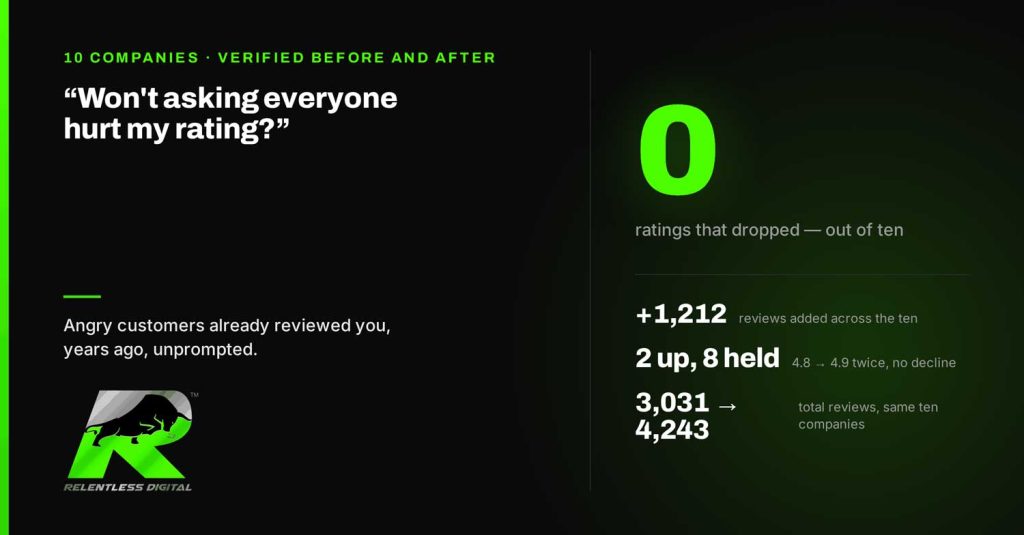
We have verified star ratings from before and after the campaign for ten of these companies. Between them, they went from 3,031 reviews to 4,243 — 1,212 new reviews from past-customer outreach.
What happened to their ratings:
Two went up. An electrical contractor in suburban Rhode Island went 4.8 → 4.9 while going from 52 reviews to 129. An HVAC company in northwest Georgia went 4.8 → 4.9 while adding 209 reviews.
Eight held exactly. Including a plumbing company in the Dallas–Fort Worth suburbs that added 290 reviews in nine days and stayed at 5.0. And an HVAC company outside Atlanta that added 112 and stayed at 5.0.
Zero went down. Not one, at any point in the range — including the 4.8s, which had the most room to fall.
Ten is ten, not a thousand. But it is ten out of ten, across four states and both trades, at every rating from 4.8 to 5.0.
Why it works this way
The mechanism is simpler than people expect, and it comes down to who actually volunteers a review.
Unhappy customers do not wait to be asked. Someone who is genuinely angry about a botched install left their review three days after the install, unprompted, at 11pm. That review is already on your profile. It has been there for years. A reactivation email does not unlock it.
Satisfied customers are the ones who never got around to it. The person whose water heater has worked flawlessly since 2022 has no emotional trigger pushing them to Google. They liked you. They forgot. They are the overwhelming majority of any past-customer list, and they are exactly who responds to being asked directly.
Volume works in your favor mathematically. A company at 4.8 with 120 reviews needs a lot of one-stars to move the needle down, and a modest run of five-stars to move it up. That is what happened to both of the companies whose rating improved: the new volume pulled the average up toward what their recent work actually deserves.
The honest caveats
If we only told you the reassuring half, you should not believe the reassuring half.
Response rates fall hard as lists get bigger. The suburban Rhode Island contractor had 103 people on its list and 77 of them left a review — a 74.8% response rate, the highest we have recorded. A company that asked 1,803 people got 41.8%. One that asked 5,469 got 7.8%. Blended across all 72 companies we have run this for, about 9.8% of contacted past customers leave a review — roughly 10 reviews per 100 people you ask. Big lists are older, colder, and full of stale email addresses. Plan on 10%, not 75%.
This is not a laundering machine. Asking everyone works because most of your customers are happy with you. If they are not, asking 2,000 of them will tell you that quickly and publicly. We are not filtering, gating, or routing anyone to a private feedback form first. Every person gets the same ask and a direct link to Google. That is the deal, and it is the only version that is worth anything.
Eight of the ten held rather than improved. Nobody’s rating jumped from 4.6 to 4.9. If you are hoping a campaign repairs a damaged reputation, that is not what this is. This adds volume and recency to a rating you have already earned.
What actually changes
Not the number of stars. The number underneath it.
That is exactly where online reputation management services come into play. The goal is not simply to increase your star rating, but to build a stronger, more active review profile that gives potential customers more confidence in your business.
A homeowner comparing three companies in a map pack is not doing decimal math between a 4.8 and a 4.9. They are looking at 4.9 with 34 reviews versus 4.8 with 340 and deciding which one is a real company. Recency matters the same way: twelve reviews in the last ninety days reads as a business that is busy right now, and eleven reviews all dated 2019 reads as a business that might not exist anymore.
That is the actual return here. You are not buying a better rating. You are buying enough reviews, recent enough, that the rating you already earned finally gets believed.
Related Reading:
Your past customers are worth about 10 Google reviews per 100. Here’s the math.
Your Second Location Is Invisible on Google. Your Customers Already Fixed It Once.