

Open Google Maps and search your trade plus the town where your second office sits. Not your main city. The satellite.
For most multi-location home service companies, one of two things happens. Either the flagship profile from the next city over shows up, or a competitor half your size owns the map pack outright. The second office has a real address, a real crew, and real trucks in real driveways — and somewhere between zero and thirty Google reviews.
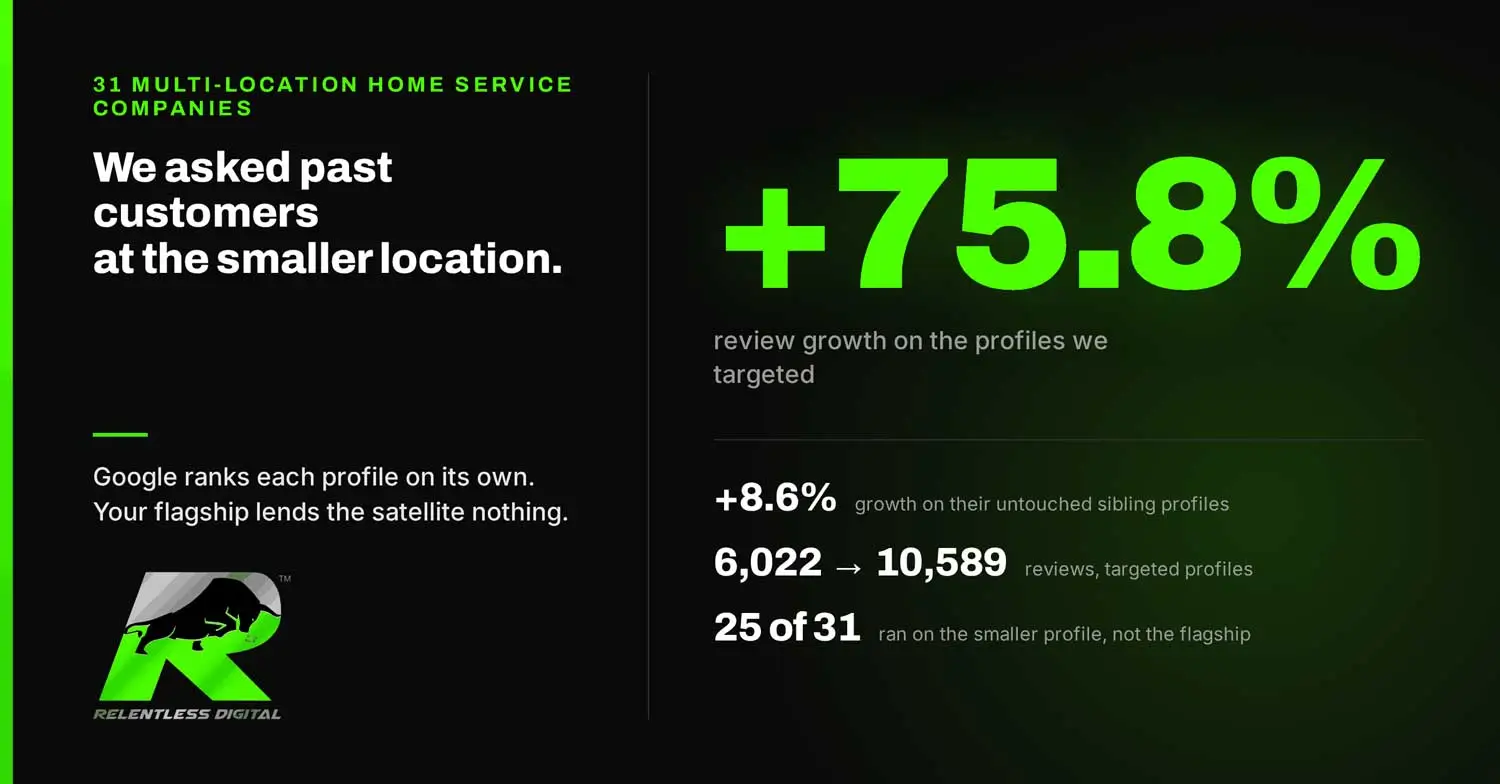
We looked at every multi-location client running our reactivation campaigns: 31 companies with more than one Google Business Profile. In 25 of the 31, the newer location carried fewer reviews than the flagship. The median satellite profile held 127 reviews. The median flagship next to it held 400.
That gap is not a service-quality gap. It is an asking gap.
Where the reviews actually go
A customer in the satellite’s service area gets great work done. They would happily leave a review. Then one of three things happens:
The tech hands them a card or a link that points at the company’s main profile, because that is the link the office has always used.
They search the company name later, land on the flagship profile because it has 400 reviews and ranks first, and review there.
Nobody asks, and they do nothing at all.
Customers do not think in Google Business Profiles. They think in company names. So the reviews pile up where the reviews already are, and the profile that most needs ranking signal never gets any. Meanwhile, Google ranks the local map pack per profile, using proximity and prominence for that specific listing. A 400-review flagship twelve miles away does not lend prominence to your satellite. It competes with it.
What happened when we pointed the ask at the smaller profile
We ran reactivation campaigns against these companies’ existing past-customer lists — no ads, no new leads, just people who had already paid them — and segmented each list by service address so the ask pointed at the nearest profile rather than the main one.
Same companies. Same months. Two very different outcomes:
| Starting reviews | Now | Growth | |
| Profiles the campaign targeted (31) | 6,022 | 10,589 | +4,567 (+75.8%) |
| Their sibling profiles, untouched (38) | 29,518 | 32,062 | +2,544 (+8.6%) |
The untargeted profiles were not neglected. They kept getting reviews the normal way — walk-ins, organic asks, techs handing out links — and grew 8.6% over the same stretch. That 8.6% is what “business as usual” looks like. The targeted profiles grew nine times faster off a much smaller base.
A few of the individual moves:
A multi-trade company in Oklahoma had a second address in the same town as its flagship carrying 13 reviews. It now has 254.
An electrical contractor outside Raleigh had a profile for its city location with zero reviews. It now has 240.
A plumbing company in the Dallas–Fort Worth suburbs had a second profile at zero. It now has 154, while the established profile it sat next to added 37.
A plumbing and HVAC company in Southern California went from 32 to 237 on its satellite. The flagship a few towns over added 61.
A plumbing and HVAC company in southwest Virginia grew its satellite from 147 to 435 — and here is the honest version of this story: the flagship across the state line grew too, 3,102 to 3,407. Both moved. But the satellite nearly tripled, and the flagship added 10%.
Why this is the cheapest ranking work available to you
You are not buying anything. You are re-contacting people who already hired you, already had a good experience, and were never asked. The cost is the campaign, and the asset is a list you already own.
For a satellite profile, the leverage is extreme. Going from 13 reviews to 254 does not just look better — it moves a listing from “not credible enough to click” to a legitimate contender in a map pack where the competitors have 80. The flagship going from 3,102 to 3,407 changes nothing about how anyone perceives it. Same work, wildly different return, depending on which profile you point it at.
What to do this week
List every Google Business Profile you own. Most multi-location companies we onboard are wrong about how many they have — old profiles, duplicates from a rebrand, a trade-specific listing someone created and forgot.
Count reviews per profile, not company-wide. Company-wide totals hide the problem completely. A company with 3,500 reviews can have a location sitting at 12.
Segment your customer list by service address. This is the whole trick. One list per location, each pointing at that location’s review link.
Start with your worst profile, not your best. The lowest-review location has the most room and the most to gain.
Check where your techs’ review link points. In most shops, every tech in every truck is sending customers to the same profile. It has been that way since the first location.
If you have more than one address on Google, you almost certainly have a location that is invisible — and the customers who could fix it are already in your database.
Related Reading:
Won’t asking every customer hurt my rating? We have ten answers and none of them dropped.
Your past customers are worth about 10 Google reviews per 100. Here’s the math.